Visitor Engagement Automation vs Chat-Only Interactions
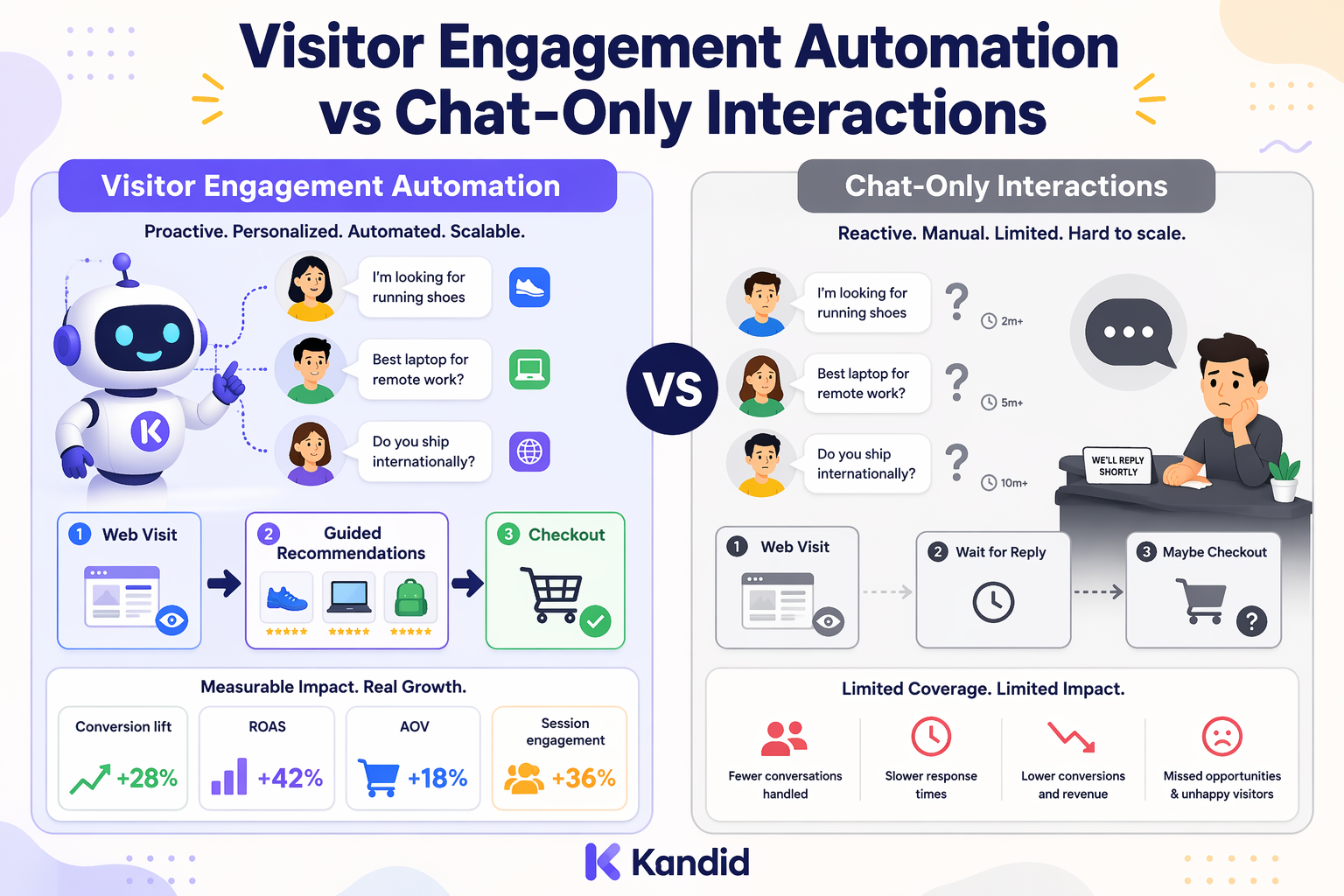
If your site relies only on chat to engage visitors, you may be missing faster conversion paths that automation can trigger before a buyer ever types a message.
Most teams accept that chat helps support. The gap is clear thinking on conversion. Can chat-only interactions really match the conversion lift, response speed, and scale that visitor engagement automation delivers?
This comparison shows where automation beats chat-only, where live chat still wins, and how to mix both for revenue-focused ecommerce and D2C teams. Written for commercial decision-makers weighing visitor engagement automation tools and real-time AI sales agents.
Quick Summary: The article compares visitor engagement automation with chat-only interactions and argues that automation is better for proactive conversion, faster response times, 24/7 coverage, and scaling repetitive pre-sale questions, especially on high-traffic ecommerce and D2C sites. It explains that automation can trigger timely, behavior-based offers on product, cart, and checkout pages, but it must use consent, clear intent signals, and limited follow-up to avoid feeling intrusive. Chat-only still has an edge for high-ticket, complex, emotional, or trust-heavy purchases where human judgment and reassurance matter most. The recommended approach is usually hybrid: let automation handle routing, timing, and simple sales guidance, then escalate to humans for nuanced conversations and edge cases.
How visitor engagement automation outperforms chat-only interactions
Chat-only is like putting a bell on the counter and hoping people ring it. Visitor engagement automation walks up to the visitor, at the right second, with the right offer.
1. Conversion moments automation can trigger earlier
Automation does not wait for a click on the widget. It fires based on behavior.
You can trigger tailored messages when visitors:
- Linger on a product page with specs or ingredients
- Scroll 60% of a long PDP but do not add to cart
- Move the mouse toward closing the tab on cart or checkout
Proactive triggers like these can recover 10-15% of abandoning users, as shown in playbooks on exit-intent and scroll-based triggers from webchatagent.com.
Tools like Kandid or Manifest can use catalog data, past behavior, and intent signals to push:
- Size or shade guidance
- Compatibility checks
- Timely bundles or cross-sells
2. Operational advantages over chat-only support
Chat-only support is linear. More conversations need more humans.
Engagement automation gives you:
- 24/7 coverage with sub-second first response
- Routing by intent, not inbox, so sales see high-intent chats first
- Lower cost per assisted sale, since bots handle the top 60-80% of questions
In controlled tests, chatbot-led setups beat human-only in first-response time by orders of magnitude and dramatically lowered cost per qualified lead, as seen in benchmarks from conferbot.com.
3. Where chat-only still has an edge
Chat-only is still strong when:
- The product is very high-ticket or complex
- The buyer needs negotiation or deep reassurance
- The conversation turns emotional (complaints, sensitive issues)
This is why the best setups pair automation for timing and triage with humans for nuance, not one or the other.
How to automate follow-up without being creepy
You are not annoying by default. You are annoying when you ignore signals, timing, and consent.
Treat follow-up like good retail staff. Step in when there is a clear cue. Back off when there is not.
1. Signals that justify a follow-up
Only automate when the visitor shows intent. Strong signals:
- Viewed pricing, cart, or checkout and stalled
- Spent serious time on a product or comparison page
- Asked a question in chat but did not finish the journey
- Started but did not complete a form or quiz
Weak signals like a 5 second homepage visit do not justify a follow-up.
If you would not call a person based on that behavior, do not automate a message either.
Tools like Kandid can score behavior in session and only trigger follow-up when the pattern matches real buying intent, not random browsing.
2. Timing, frequency, and consent guardrails
Think like a guest, not a stalker:
- Get clear consent for email, SMS, or WhatsApp
- Send 1 follow-up within 24 hours for high intent actions
- Cap at 3-4 touches total, like many email studies recommend across follow-up sequences on prospeo.io
- Stop instantly on reply or purchase
Spacing matters. Research shared on instantly.ai shows 2-3 days between early touches, then longer gaps later to avoid fatigue.
3. Examples that feel helpful, not intrusive
Creepy:
- "We saw you looking at this bra for 6 minutes. Want help?"
Helpful:
- "Still choosing size for the Everyday Support Bra? Here is a 30 second fit guide."
- "Your EV roof rack is still in your cart. Want a quick check on car compatibility?"
Keep each follow-up:
- Tied to a clear action
- Focused on one next step
- Easy to ignore without guilt
If your message feels like a nudge from a smart shop assistant, you are in the safe zone.
Which model should your team choose?
You do not need a philosophical answer. You need a revenue answer.
1. Choose automation if your goal is scale and conversion lift
Go automation-first if:
- You have 500+ monthly chats or high traffic.
- 50 percent or more of questions are repeatable.
- You sell many SKUs or complex products.
AI agents shine on speed, coverage, and cost. Benchmarks show AI can handle 60 to 80 percent of volume with instant replies while humans focus on high value chats, which lines up with hybrid guidance from chattsy.io and canarychat.app.

Tools like Kandid, Manifest, and Sage Pilot go further than support bots. They act like 24/7 sales reps that:
- Decode specs.
- Compare options.
- Push shoppers to the right product.
If your main KPI is conversion lift or ROAS, start with automation plus human escalation.
2. Choose chat-only if human trust is the primary conversion lever
Stay chat-only when:
- Each conversation is high stakes.
- A single order is worth thousands.
- Customers buy on relationship, not speed.
Think custom EV builds, medical devices, or regulated finance. A misstep from automation costs more than a missed chat.
Chat-only fits when:
- Your volume is low enough for humans to answer fast.
- Most questions need deep context, negotiation, or empathy.
You can still use light automation in the background for routing, notes, and drafts. Just keep a human as the visible face.
If your main lever is trust, reviews, and referrals, protect the human layer. Use AI to support your team, not front it.
Review your current visitor engagement flow and identify one high-intent page where automation could improve conversion without increasing team workload.
Then plug in Kandid to add a real-time AI sales agent that converts that traffic 24/7.
Frequently Asked Questions
Q1: When should I move from chat-only to visitor engagement automation?
Switch once you have steady traffic and clear drop-off points, like product or cart pages. If your team cannot respond in under a minute, or you see many repeated pre-sale questions, automation will win on conversion and lower support load.
Q2: How does automation improve conversions compared to live chat?
Automation reacts in real time to behavior, not just questions. It can trigger tailored messages on high intent actions, like repeat visits or checkout hesitations. That means fewer abandoned carts, more guided product discovery, and more consistent sales coverage than human-only chat.
Q3: What happens if automation gives a wrong or weird answer?
Bad answers usually come from poor setup, not the concept itself. Fix it by tightening product data, adding guardrails, and routing edge cases to humans. Tools like Kandid or Manifest work best when you define clear fallbacks for unclear intent or sensitive topics.
Q4: Who inside my team should own visitor engagement automation?
Give ownership to whoever owns revenue from the site, often the head of ecommerce or performance marketing. They understand funnel leaks. Involve CX to shape tone and rules. Engineering should only support implementation, not day-to-day journey design or message logic.
Conclusion
Visitor engagement automation wins on scale and proactive conversion. It reacts to behavior in real time and covers the 40%+ of traffic that arrives after hours, where human-only chat simply cannot keep up, as pattern data on hybrid chat shows conferbot.com. Chat-only still matters when trust and nuance rule the decision, especially for high-ticket or sensitive journeys.
The best teams do not choose sides. They let automation handle trigger-based engagement, routing, and privacy-safe follow up, then bring humans in for high-empathy conversations where context, reassurance, and judgment close the sale.