Visitor Engagement Automation Updates: 2026 Benchmarks
In 2026, the fastest-growing ecommerce teams are no longer asking whether visitor engagement automation works - they are asking which numbers prove it works.
Most teams still track the wrong signals: clicks, chatbot opens, or time on site, without knowing whether AI chatbots, recommenders, quizzes, or calculators are lifting conversion rate, ROAS, AOV, or lead quality.
This article breaks down the core benchmarks that matter for visitor engagement automation in 2026, how to read them in GA4, and how to tell whether your program is outperforming the market.
It is built for D2C and ecommerce operators who manage conversion-focused automation across high-intent shopping journeys, with KPI framing aligned to current performance measurement practices.
Quick Summary: The article argues that in 2026, visitor engagement automation should be judged by revenue outcomes rather than vanity engagement metrics like time on site, pageviews, or scroll depth. It identifies a benchmark stack built around conversion and lead quality, revenue lift, and behavioral quality, with emphasis on AI-assisted sessions, AOV, ROAS, and AI-attributed revenue, noting that AI-driven traffic often converts materially better than baseline if the setup is working. It also explains how to track these benchmarks in GA4 with specific event tags and funnel comparisons between AI and non-AI traffic, while warning that strong clicks without revenue indicate misaligned intent and should trigger fixes to prompts, targeting, funnel design, or page speed rather than a tool swap.
What 2026 benchmark shifts mean for visitor engagement automation
Engagement is down on paper but up in intent. Contentsquare’s 2026 benchmarks show engagement rates down about 10%, with fewer pages per session and less scrolling, while bounce rates improve and AI-referred visitors arrive more prepared and ready to act contentsquare.com. That means your automation stack has to optimize for speed-to-answer and purchase clarity, not passive browsing.
1. Which metrics matter most this year
Stop staring at vanity engagement and start tracking outcomes per visit:
- Engaged sessions in GA4 tied to revenue, not just time.
- Events per session that map to intent: add-to-cart, variant views, shipping checks, compare clicks.
- Conversion rate by intent source, especially AI-referred and returning visitors, which now drive over half of traffic and convert better than new users contentsquare.com.
- AOV and ROAS lift when a visitor talks to an AI agent vs no agent.
Your benchmark is not "time on site" - it is revenue per high-intent session.
2. Why legacy engagement metrics are less useful
Time on page, raw pageviews, and scroll depth tell you almost nothing in 2026. Sessions are shorter by design because visitors arrive with clearer intent and want fast answers. A shopper who lands on a product detail page, asks an AI agent one question, and checks out in three minutes is a win, not a low-engagement session. Legacy metrics punish that behavior.
You need GA4 event design, Looker Studio views, and your ecommerce attribution tool aligned around a simple idea: measure how well your automation removes friction and turns intent into money, not how long people hang around.
The KPIs that should define your benchmark stack
You do not need 50 metrics. You need a tight stack that predicts revenue and keeps your team honest.
Use three layers: conversion and lead quality, revenue lift, and behavioral quality. That stack is what separates vanity dashboards from real performance reporting, as shown in broader marketing KPI work like digitalapplied.com.
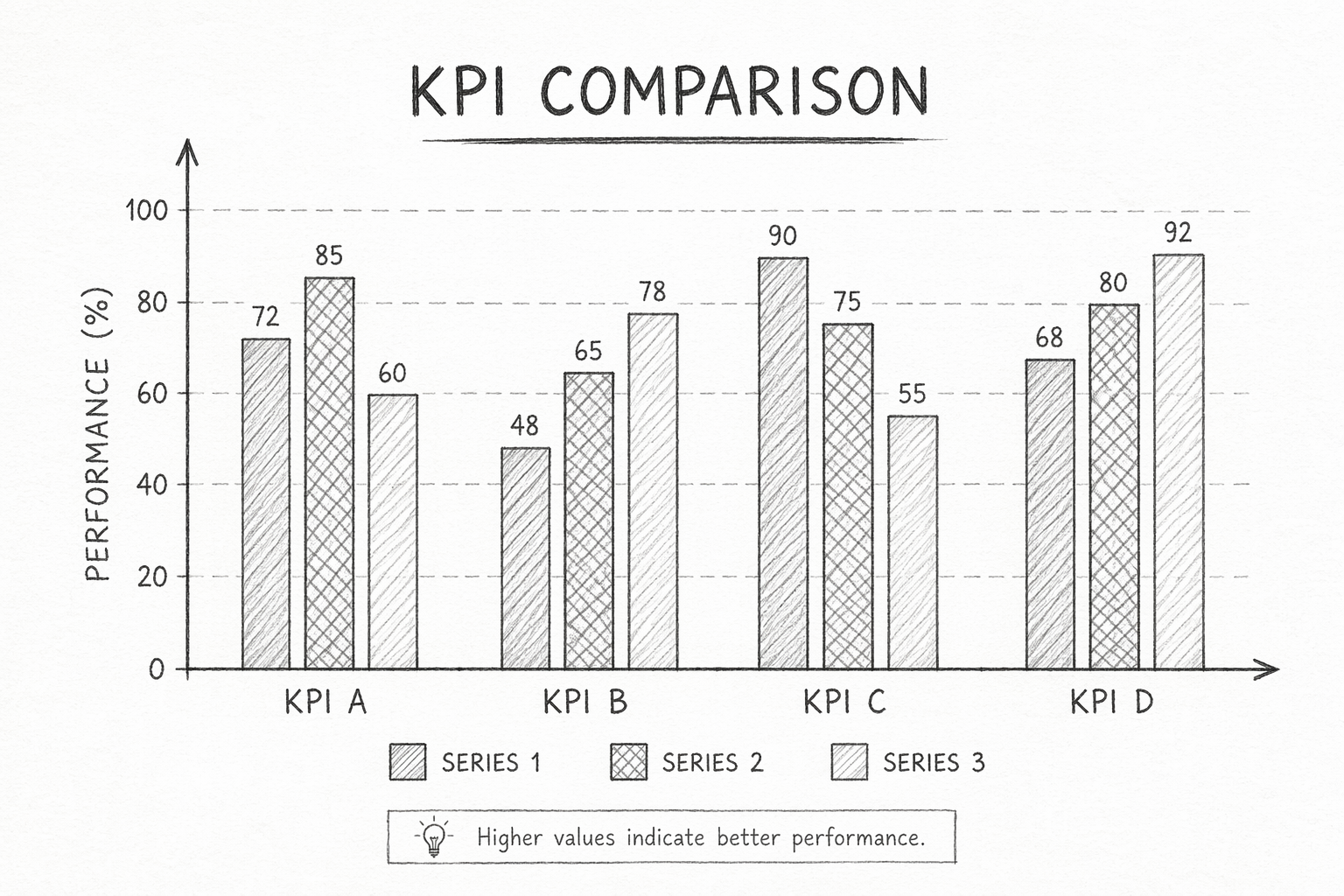
1. Conversion and lead quality KPIs
Track how well AI-assisted traffic actually buys:
- Overall conversion rate (sessions to orders)
- AI-assisted conversion rate vs site average
- Add-to-cart rate and checkout completion rate
- Lead quality rate for high-ticket flows (e.g. pre-order forms)
Benchmarks from ecommerce AI agent studies like salesmate.io show:
- 10-35% relative conversion uplift
- 2-4x higher conversion in AI-assisted sessions
If your AI sessions are not at least 2x baseline, something is off with targeting, prompts, or product data.
2. Revenue lift KPIs
This is what leadership actually cares about:
- AI-attributed revenue % of total
- AOV lift in AI sessions
- ROAS lift on traffic exposed to AI
- Contribution margin from AI-influenced orders
Set explicit targets, not vibes. Many mature deployments see AI influence 20-30% of revenue; some assistants, like those profiled on alhena.ai, hit similar ranges.
3. Behavioral quality KPIs
These tell you why numbers move:
- AI engagement rate (share of visitors who interact)
- Session depth (events per session, scroll depth, key interactions in GA4)
- CSAT / thumbs-up rate on answers
- Escalation rate to human support
High engagement with flat conversion means misaligned intent. High CSAT with low revenue usually means the assistant is too support-focused and not assertive enough about products.
How to track these benchmarks in GA4 and AI funnels
1. Events to tag for each engagement tool
Start with a clean base. Make sure GA4 is firing view_item, add_to_cart, begin_checkout, and purchase correctly for all traffic, not just AI visits, as stressed in analytics-agent.app.
Then layer AI specific tags in GTM:
- Agent engagement:
ai_chat_open,ai_message_sent,ai_recommendation_click - Outcome links:
ai_add_to_cart,ai_begin_checkout,ai_purchase_assist - Context parameters:
agent_name(Kandid vs other),agent_interaction_type(assisted, autonomous),agent_session_id
Register these as event scoped custom dimensions, like the AI agent dimensions used in analytics-agent.app, so you can break out funnels by tool.

2. How to compare performance against a baseline
In GA4 Explorations:
- Build a funnel with steps:
session_start->view_item->add_to_cart->begin_checkout->purchase. - Add a segment where
agent_nameequals your AI tool, and another where it is unset (non agent traffic). - Compare:
- Conversion rate lift
- AOV difference
- Cart abandonment
- Time to purchase
Pull this into Looker Studio to trend AI vs non AI over time and see if agent traffic is moving the same KPIs leadership cares about.
What to do when your benchmarks are below target
Benchmarks below target are a smoke alarm, not a verdict.
Fast fixes that usually move the needle
Start with simple, high impact changes that match what shopify.com and convin.ai call out as core:
- Cut LCP under 2.5 seconds on key PDPs
- Tighten CTAs and simplify navigation
- Add real-time help, like Kandid, on high intent pages
Use these 2026 benchmarks to audit your visitor engagement automation stack, then review the parent pillar page for the full strategy framework.
Next, turn those targets into real revenue by testing Kandid as your always-on AI sales agent for high-intent traffic.
Frequently Asked Questions
Q1: How often should we refresh our 2026 engagement benchmarks?
Review benchmarks quarterly. Traffic mix, campaigns, and seasons shift fast. Use GA4 and your attribution tool to check if conversion rate, AOV, and assisted revenue by automation are trending up. If 2 quarters flatline, reset targets and test new journeys.
Q2: What GA4 events matter most for visitor engagement automation?
Track a tight core set: session_start, view_item, view_item_list, add_to_cart, begin_checkout, purchase, and key engagement events like click_recommendation or start_chat. Tie every automation touchpoint to one of these so you can see lift in revenue, not just clicks.
Q3: How do we tell if Kandid or any AI agent is beating our current benchmarks?
Run a clean A/B test. Split traffic: control uses your current site, variant uses Kandid for visitor engagement. Compare conversion rate, revenue per session, AOV, and time to purchase. If Kandid beats your 2025 baseline by at least 10 to 15 percent, scale it.
Q4: What happens if our engagement automation improves clicks but not revenue?
Treat that as a red flag. It means your flows chase attention, not buying intent. Tighten triggers, shorten journeys, and push clearer product paths. Always judge automation on revenue, margin, and ROAS impact, not session engagement alone.
Conclusion
In 2026, visitor engagement automation must be judged by outcomes, not raw interaction volume. Anchor on conversion rate, lead conversion rate, ROAS, AOV, and engaged sessions. Use clean GA4 event tracking for reliable benchmarks and fix funnel design and event taxonomy before swapping tools.