Real Time Shopping vs Delayed Personalization: Tradeoffs
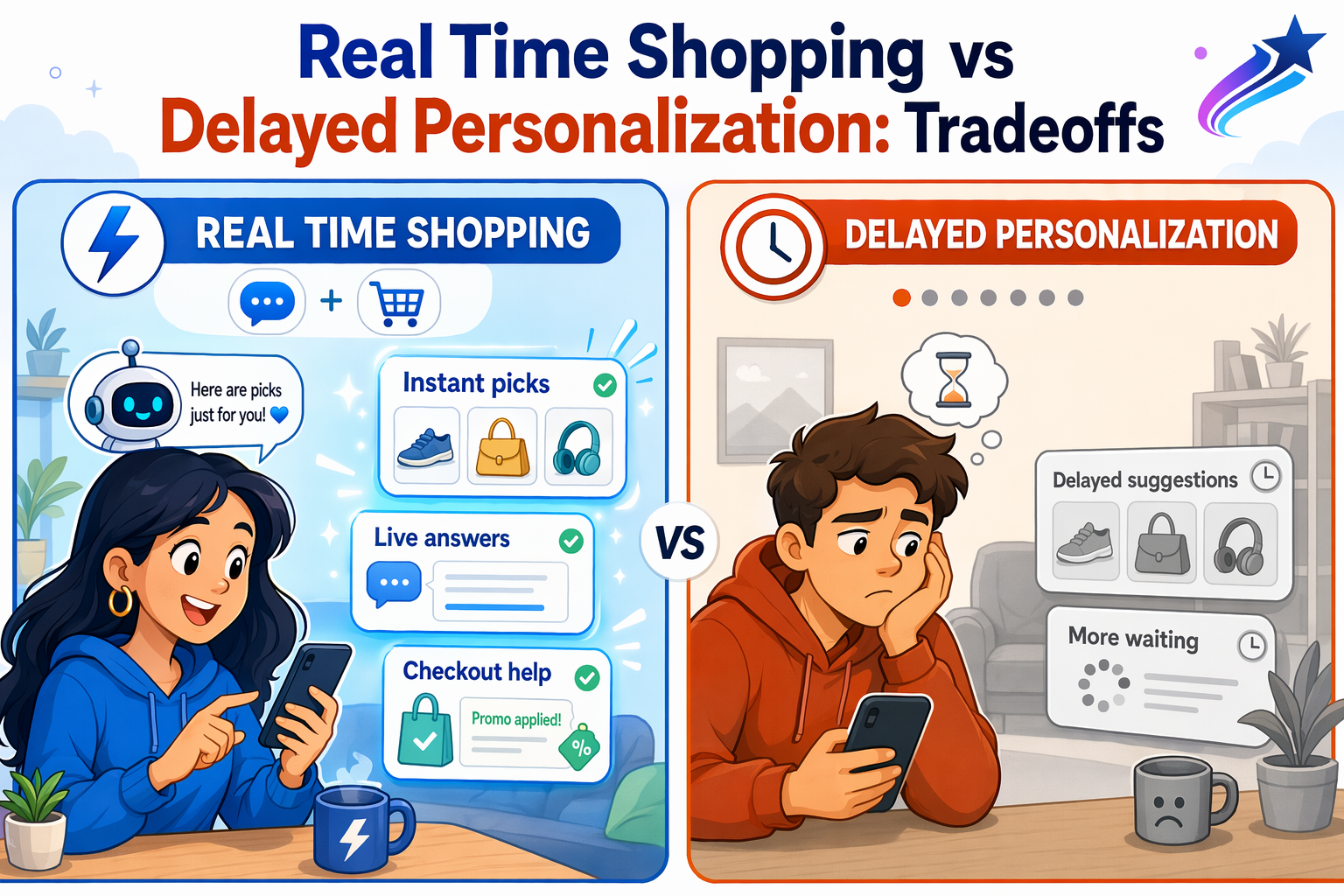
The wrong personalization timing can be almost as costly as no personalization at all.
Many teams assume real time personalization is always the win, but real time shopping and delayed personalization solve different problems and carry very different costs.
This article breaks down the tradeoffs, shows when delayed personalization can beat real time personalization, and gives a simple, conversion-first way to choose your timing model.
Built for ecommerce operators who judge real time personalization by revenue, site performance, and complexity.
Real-Time Shopping vs Delayed Personalization: What Changes in Practice
How real-time shopping responds to live behavior
Real-time engines react while the shopper is still active. They read clicks, scroll depth, search terms, and cart changes, then adapt content on the spot. McKinsey notes that personalization can lift revenue by 10 to 15 percent when done well, especially with in-session signals McKinsey on personalization.
Think: a shopper asks a question, compares two products, and the site updates guidance right away.
Where delayed personalization still works well
Delayed personalization uses past behavior and batch updates. It shines in email flows, post-purchase journeys, and homepage layouts for returning users. A report from Harvard Business Review highlights that many brands start with rule-based and batched personalization before moving to real time.
Use it when speed is less critical than stability and low engineering lift.
The core tradeoff: immediacy versus efficiency
Real-time systems like Kandid or Helium give immediacy: higher relevance per session, but more data, infra, and QA work. Delayed systems give efficiency: simpler pipelines, cheaper compute, fewer failure modes.
- Choose real time for high-intent, complex purchases.
- Use delayed for broad lifecycle nudges and lower-stakes visits.
When Delayed Personalization Outperforms Real-Time Shopping
Some sites do better when they personalize after the visit, not during it. Delayed personalization can be smarter when product choice changes slowly, offline signals matter, and your team must control risk and cost.

Low-velocity catalogs and repeat-purchase cycles
Delayed personalization fits brands where the catalog barely changes and customers buy on a schedule.
Examples: EV chargers, high end electronics, skincare refills.
Retail studies note that many shoppers still research over several days before purchase, especially for high value items, which reduces the upside of split second changes during a single session National Retail Federation research.
Use delayed personalization when:
- Products last years or months.
- Customers compare a lot before buying.
- Email and remarketing drive most sales.
When data quality is stronger than data speed
Real time systems react fast, but they often rely on weak or noisy signals from a single visit. Higher quality data from a customer data platform or offline CRM can predict intent far better, especially when it includes support tickets, returns, or warranty claims.
A report from McKinsey highlights that firms using broader data sets see much bigger gains from personalization.
Delayed personalization can:
- Use verified purchase history.
- Blend survey, loyalty, and support data.
- Train cleaner models in your personalization analytics dashboard.
Why delayed personalization can reduce risk and cost
Real time personalization needs heavier event tracking tools, strict latency budgets, and complex testing. That adds cost and more ways to break your funnel.
Delayed tactics lower risk because they:
- Run in controlled channels like email and SMS.
- Change less often, so QA is simpler.
- Depend more on A/B tests than streaming code.
Use delayed personalization if:
- Your dev team is small.
- Compliance review is slow.
- You are still fixing basic tracking.
How Fast Must Personalization Update to Move Conversion Rates?
The latency window that matters most
Most shoppers decide fast. Many retail and ecommerce sessions last under 5 minutes, and a big share of orders complete in the first visit, according to McKinsey research on personalization. So the key window is the current session, not the week.
If a shopper changes intent mid-visit, but your recommendations update only on the next visit, you lose that swing.
Aim to react within:
- 1 to 5 seconds for on-site changes
- Same session for cart and product views
- 24 hours for email or ad retargeting
If behavior shifts inside a session, that is where real-time logic pays off.
A practical decision rule for ecommerce teams
Use this simple rule:
- If the action is on-site and high intent (add to cart, filter use, configuration change), treat it as real time. Your personalization logic should react in under a few seconds.
- If the action is off-site or low intent (email open, blog view), delayed personalization within a day is fine and often cheaper.
Focus real time where the user is one or two clicks from buying.
A personalization analytics dashboard and A/B testing platform help you see where lower latency actually moves conversion rates.
recommendation: Choose the Timing Model That Matches Your Commerce Motion
Real time is not always better. Match timing to how people actually shop your products. Research from McKinsey shows that strong personalization can lift revenue by up to 15 percent, but only when aligned with clear goals and data foundations McKinsey personalization research.
Use this quick rule of thumb:
- Choose delayed personalization if:
- Your catalog is simple and AOV is low
- Traffic is volatile but intent is mixed
- You lack clean event tracking or a strong customer data platform
- Your team cannot monitor real time systems yet
- Choose real time if:
- Your products are complex (EVs, tech, skincare routines)
- Buyers need comparison or spec decoding on site
- You run high-intent performance traffic and care about ROAS
- You already trust your tracking, tagging, and personalization analytics dashboard
Treat timing as a roadmap, not a bet. Many brands start with delayed personalization and move to session level and real time once they see clear conversion gains and can support the extra complexity.
Audit your current personalization timing, then share this comparison with your team. See how Kandid brings real-time shopping to life for your brand.
Frequently Asked Questions
Q1: What are the main tradeoffs between real-time shopping and delayed personalization?
Real-time gives higher relevance but needs strong data, low latency, and careful guardrails. Delayed personalization is simpler, cheaper, and safer for testing but misses intent spikes. Many teams start delayed, then add real-time where conversion impact is clear.
Q2: When does delayed personalization outperform real-time shopping?
Delayed works best with slower, researched purchases, small catalogs, or when data quality is shaky. It also wins when your team is early in experimentation and wants clean A/B tests before adding real-time complexity or AI agents like Kandid.
Q3: How fast must personalization update to impact conversion rates?
For live browsing, updates should react within 1 to 2 seconds of key events like filter changes or add-to-cart. For email, ads, and flows, same-day updates are usually enough, as long as they reflect the last few sessions.
Conclusion
Real time shopping works best when intent is hot, session behavior is rich, and the page can still shift the purchase. Delayed personalization can win when data quality, governance, and stability matter more than speed, which recent personalization research also supports https://hbr.org/.
The right timing depends on three things:
- Conversion window - minutes vs days
- Traffic quality - high intent vs casual
- Operational maturity - can your team safely run and monitor real time rules with your customer data platform and testing tools