D2C Product Recommendations Engine: Build Your First Model
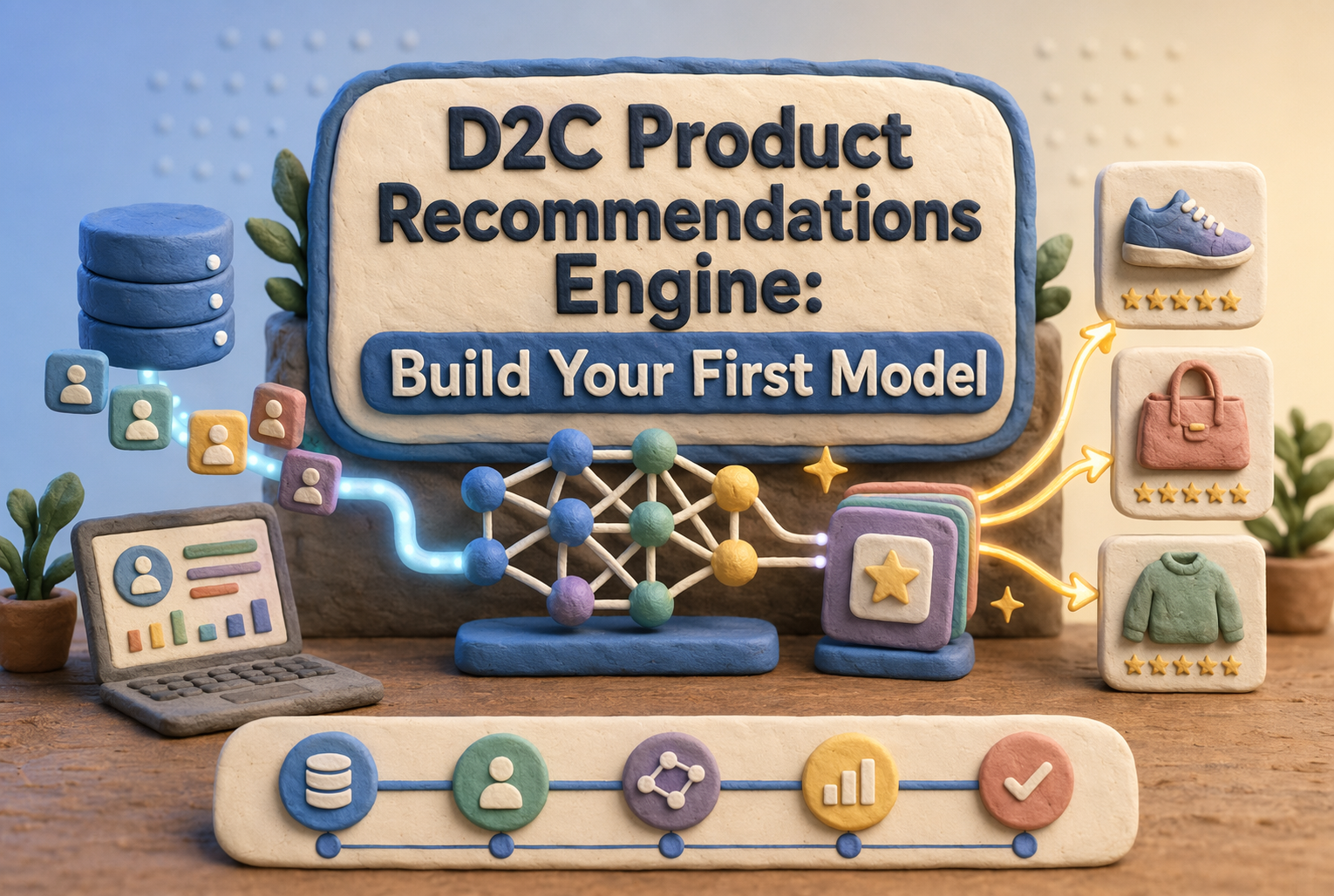
If you only had one chance to ship a recommendation engine on your D2C store, what exactly would you build first? Most teams either drown in complex models or ship generic product recommendations that do not move revenue. This guide walks you through a focused first recommendation engine, built for real D2C personalization, with clear steps tied to business impact instead of vanity metrics.
Choose the right first recommendation use case
Pick one surface with clear conversion impact
Start with one place where better suggestions clearly drive money, not five experiments at once. For most D2C brands that is:
- Product detail page: "you may also like" or "similar items"
- Cart page: "frequently bought together" add ons
- Homepage: "recommended for you" band for return visitors
These are the most common high impact placements in ecommerce, according to guides on product recommendation engines and AI recommendation systems.

Tie your first recommendation engine test to a surface you already track for conversion and AOV.
Define the recommendation goal before the model
Decide the single metric that defines success:
- More add to carts
- Higher AOV
- Fewer exits on key pages
Then write a one line goal like: "Increase PDP add to cart rate by 10 percent using related item recommendations."
This keeps you from chasing fancy model ideas before you know what you want the recommendation engine to change.
Gather the minimum viable data signals
Use the three signal buckets that matter first
You do not need big data. You need the right data. Start with 3 signal buckets:
- Behavioral: product views, clicks, add-to-cart, purchases. These implicit signals power most ecommerce recommenders, as seen in large platforms like eBay personalized ecommerce recommendations.
- Product metadata: category, price, tags, technical specs, compatibility.
- Context: device, traffic source, country, session depth.
Map these into a simple recommendation baseline spreadsheet before you think about models.

Handle sparse data without stalling the project
Sparse data is normal for D2C. When behavior is thin:
- Lean harder on product metadata similarity for lookalike items, a standard cold-start tactic in research on sparse recommenders multimodal cold-start methods.
- Use sitewide popularity and new-arrival boosts as safe fallbacks.
- Let tools like Kandid or Manifest enrich product attributes automatically.
Do not wait for perfect data. Ship a first-pass rules model and improve it.
Create a clean event schema for training and testing
Define one simple schema that analytics, your AI agent, and your A/B testing platform all share:
- User/session IDs
- Event type: view, click, add_to_cart, purchase
- Item ID + quantity + price
- Timestamps and channel/source
Store this in your analytics event tracker and keep naming strict and stable. Your future model training, uplift analysis, and debugging all depend on this clean event layer.
Build the first model and deploy a simple baseline
Start with the simplest model that can learn
Skip complex deep models first. Start with a basic item-item collaborative filtering model trained on user-product interactions. This can already beat a raw popularity list, which is often used as a non-personalized baseline in recommendation systems according to RecTools documentation.
Use this stack:
- Inputs: user ID, product ID, event type
- Output: top-N products per user or session
Keep a simple popularity list as a fallback for cold-start traffic.
Translate signals into features
Turn raw events into features:
- Count views, adds to cart, and buys per user-product pair
- Add recency buckets (last 24h, 7d, 30d)
- Derive intent scores like: buy = 3, add to cart = 2, view = 1
Summed intent score becomes your interaction strength, similar to many collaborative filtering setups in Spark ML docs.
Deploy a lightweight recommendation output
Start with a lightweight output that you can ship fast:
- Precompute daily top-N for each user segment
- Serve from a key-value store or CDN-friendly JSON
Feed this into:
- Simple "You might also like" widgets
- Chat agents like Kandid that can blend model picks with live Q&A
Evaluate recommendations with uplift, not just accuracy
Measure business lift with the right experiment
Set up a clean A/B test: control sees your old recommendations, treatment sees the new model. Track lift in revenue per session, AOV, and conversion, not just clicks. Uplift modeling research shows you need treatment vs control data to measure true causal impact on behavior, not predictions alone, as explained in this uplift modeling survey.
Always fix bugs and UX gaps in both variants first, or your test will lie.
Use accuracy as a diagnostic, not the final decision
Offline accuracy helps you debug, not choose winners. A model with slightly lower accuracy can still drive more revenue if it shifts shopper behavior more, which uplift-focused work on recommendation systems backs up in this benchmark.
Use:
- Accuracy and recall to find data or labeling issues
- Uplift in revenue and conversion to decide what to ship
Audit your current data signals and choose one recommendation surface to launch as a first model. Then plug in Kandid to turn that logic into a 24/7 AI sales agent that explains options, answers product questions, and drives lift fast.
Frequently Asked Questions
Q1: How do I build a D2C product recommendations engine for my first model?
Start simple: export your product catalog, track views/add-to-cart/purchases, then build rules like "bought X, show Y" and "viewed X, show similar." Ship to one placement, A/B test, then upgrade to an ML model.
Q2: What data signals do I need to recommend the right product on a D2C site?
Use a mix of: product attributes, on-site behavior (views, carts, search), basic customer info (location, device), and outcomes (purchases, returns). If you use Kandid or similar, also feed chat questions and objections as high-intent signals.
Q3: How should I evaluate recommendations using uplift, not just model accuracy?
Run an A/B test: control sees your current layout, variant sees the model. Track uplift in CTR on recs, add-to-cart rate, AOV, and revenue per session. Let that beat "accuracy" screenshots every time.
Conclusion
Start with one high-impact surface, like PDP or cart, not full-site coverage. Use minimum viable signals (views, adds, buys) before advanced models. Ship a simple baseline, then refine features and ranking. Modern work, like Shopify’s generative recommendations, shows real value when teams measure uplift in conversion and revenue, not only model accuracy.